
Steel Angle (Hot-Rolled Angle Bar)
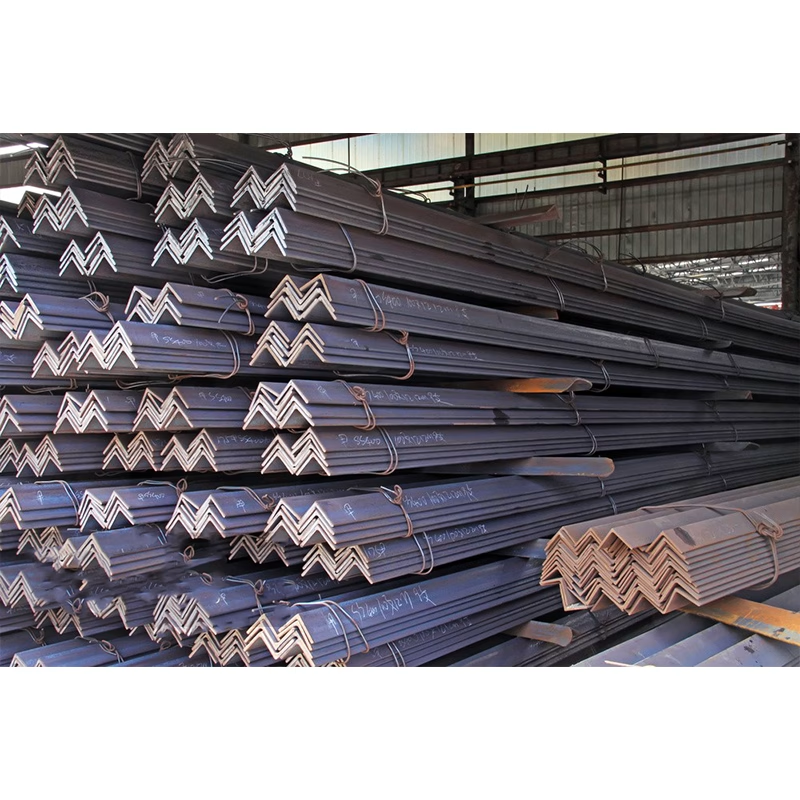
Steel angle, commonly known as angle iron, is an L-shaped hot-rolled structural section with two legs of either equal or unequal length, primarily used for bracing, framing, supports, and reinforcing edges.
Material
Structural Carbon Steel. Common grades include ASTM A36, EN 10025-2 S235JR/S275JR/S355JR, JIS G3101 SS400, GB/T 706 Q235B.
Model
Equal Angle (L), Unequal Angle (L), with designations like L 50x50x5 or L 100x75x8.
Size
Leg lengths typically range from 20 mm to 250 mm for equal angles, and various combinations for unequal angles (e.g., 100×75 mm). Thickness ranges from 3 mm to 30 mm.
Thickness
Refers to the thickness of each leg, typically ranging from 3 mm to 30 mm depending on the leg size.
Standard
EN 10056-1 (Equal and unequal angles), ASTM A6/A6M (Angle sections), JIS G3192 (Hot-rolled angles), GB/T 706 (Angle steel).
MOQ
10 Metric Tons.
Delivery Time
Standard lead time is 3 to 6 weeks for mill production; common sizes are often available from stock with 2-3 week delivery.
Long Description
Steel angle is a fundamental long product manufactured by hot rolling steel billets into a 90-degree angular cross-section. This profile consists of two perpendicular legs which can be of equal or unequal dimensions, providing versatility in load-bearing and connection applications. The section’s geometry offers good strength relative to its weight, with high strength-to-weight ratio about both principal axes when used as a bracing member. Angles are extensively used in construction to connect beams and columns, as well as in machinery for frames and brackets. They are categorized by leg dimensions and thickness, and are produced in standard lengths or cut-to-size. The simplicity of the shape allows for easy fabrication through cutting, drilling, welding, and bolting, making it one of the most common and versatile structural components in industrial and construction applications.
Key Product Highlights
The angle section provides versatile biaxial strength and is ideal for bracing against buckling in structures.
Available in both equal leg and unequal leg configurations to suit specific design and connection requirements.
Simple geometry allows for easy fabrication, connection, and integration with other structural members.
Hot-rolled production ensures consistent mechanical properties and material quality throughout the length.
It serves as a cost-effective solution for a wide range of light to medium-duty structural and support applications.
Product Advantages
Standardized sizes and global availability simplify specification, sourcing, and inventory management.
The shape allows for strong, multi-directional connections when used in pairs (back-to-back) or with gusset plates.
Full material traceability is maintained with mill test certificates compliant with international structural standards.
Can be easily cut, punched, welded, and bent (within limits) to create custom brackets, frames, and supports.
Often available from stock in a wide range of common sizes for fast delivery on maintenance and small projects.
Industry Application
This section is used for structural bracing in buildings and towers, framing for platforms and staircases, reinforcing corners in bins and containers, vehicle chassis components, machinery guards, and as supports for piping and ductwork.
Technical Specifications
| Parameter | Unit | Equal Angle (e.g., 50x50x5) | Unequal Angle (e.g., 100x75x8) | Notes |
|---|---|---|---|---|
| Carbon Content (C) | % | ≤ 0.17 (S235JR) | ≤ 0.20 (S355JR) | Grade dependent. Example values for common grades. |
| Manganese (Mn) | % | ≤ 1.40 | ≤ 1.60 | Varies by steel grade specification. |
| Phosphorus (P) | % | ≤ 0.045 | ≤ 0.045 | Maximum per common structural grade specs. |
| Sulfur (S) | % | ≤ 0.045 | ≤ 0.045 | Maximum per common structural grade specs. |
| Tensile Strength | MPa | 360 – 510 (S235JR) | 470 – 630 (S355JR) | Grade dependent range. |
| Yield Strength | MPa | ≥ 235 (S235JR) | ≥ 355 (S355JR) | Minimum ReH value for the specified grade. |
| Elongation | % | ≥ 26 (S235JR) | ≥ 22 (S355JR) | Minimum longitudinal value for the grade. |
| Hardness | HB | N/A | N/A | Not a standard specified property for structural angles. |
| Leg Length 1 | mm | 50 | 100 | First leg dimension in the designation. |
| Leg Length 2 | mm | 50 | 75 | Second leg dimension; equal in equal angles. |
| Leg Thickness | mm | 5 | 8 | Thickness common to both legs. |
| Surface Treatment | – | As-Rolled (mill scale) | As-Rolled (mill scale) | Standard delivery condition from the mill. |
| Coating / Finish | – | None (mill scale), Primed | None (mill scale), Primed | Can be supplied blast-cleaned and primed. |
| Rolling Type | – | Hot Rolling | Hot Rolling | Structural angles are produced by hot rolling. |
| Standard Example | – | EN 10056-1 50x50x5 S235JR | EN 10056-1 100x75x8 S355JR | Representative section designation and material standard. |
Packaging & Surface Treatment
Angles are bundled securely with steel strapping. For long lengths, multiple straps are applied to prevent bending and twisting. Bundles are typically stacked on wooden pallets or cradles for stability during transport. The standard surface condition is as-rolled with a layer of mill scale. Upon request, angles can be supplied descaled (shot blasted) and painted with a shop primer for immediate corrosion protection and improved paint adhesion.
Aliases Names
Angle Iron, L Angle, Equal Angle Bar, Unequal Angle Bar, Structural Angle, Rolled Steel Angle, MS Angle.
